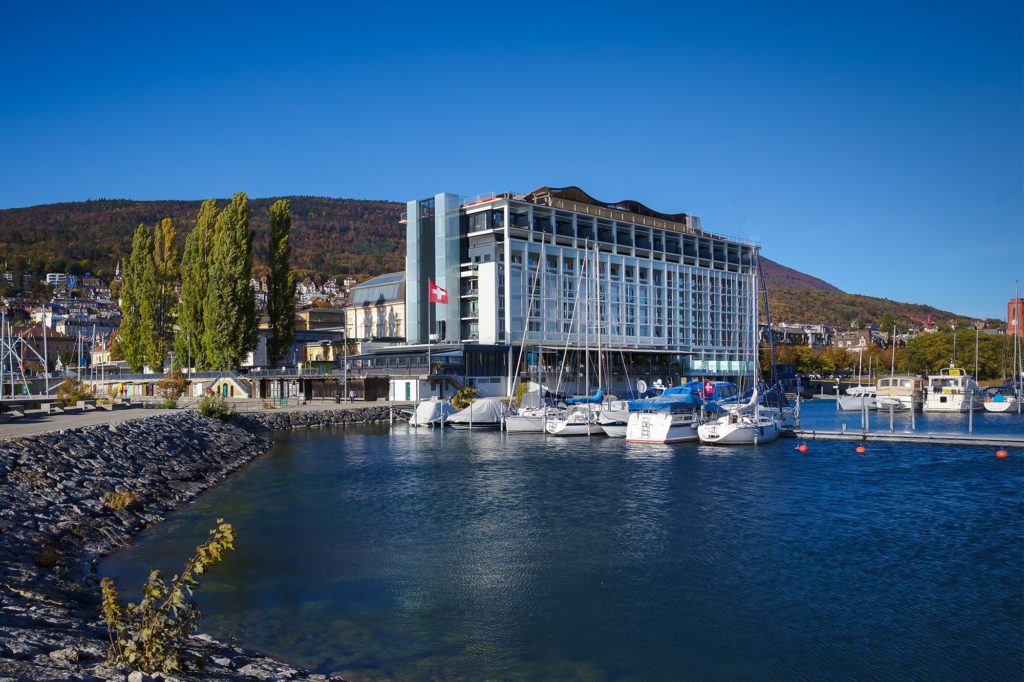
Ask most people whether Switzerland ever had a king and they will say no. They would be almost right. Until 1848, the canton of Neuchâtel was also a principality, and its prince was the King of Prussia. The day it stopped being one is still a public holiday there, and only there: every 1 March, a brass band plays in the dark at a quarter to five in the morning, cannon fire sends several hundred walkers off on a thirty-kilometre march to the castle, and the fairground rides turn on the harbour front. It is a singular day in the Swiss calendar, and almost nobody outside the canton knows about it. In 2027, 1 March falls on a Monday, which makes for a long weekend. If you want to see it from the harbour, a few steps from where the day begins, book your stay at Hôtel Beaulac at beaulac.ch.
A Swiss canton with a Prussian prince
In 1707, Marie de Nemours, Princess of Neuchâtel, died without a direct heir. The burghers of Neuchâtel chose as their new prince the King of Prussia, Frederick I. After a Napoleonic interlude, during which the principality was handed to Marshal Berthier, Neuchâtel returned to Prussia. Then, on 12 September 1814, the Swiss Diet admitted it to the Confederation as its 21st canton, alongside Valais and Geneva.
For more than thirty years, Neuchâtel lived with a dual status unlike anywhere else in Switzerland: a canton of the Confederation on one side, a principality belonging to the Prussian crown on the other. A first republican uprising failed in 1831.
In late February 1848, news of the revolution in Paris reached the mountain towns of the canton. In Le Locle, on the evening of 28 February, republicans raised the Swiss flag outside the Hôtel de la Fleur-de-Lys. On 29 February, since 1848 was a leap year, they took control of the town, and La Chaux-de-Fonds and the Val-de-Travers soon followed.
On the morning of 1 March, a column of around 800 volunteers led by Fritz Courvoisier and Ami Girard set off for Neuchâtel. Snow was falling in squalls, and horse-drawn ploughs cleared the road at the front. They halted at noon on the Vue-des-Alpes pass, picked up reinforcements in the Val-de-Ruz, accepted the surrender of a small royalist unit at Malvilliers and captured two cannons at Valangin. They never had to fight: the royalist government had left the castle before they arrived. At nine that evening, Alexis-Marie Piaget formed the first republican government.

Der Neuenburgerhandel: als die Schweiz fast gegen Preussen marschierte
Erledigt war die Sache damit nicht. Im September 1856 besetzten Royalisten in einem Handstreich das Schloss Neuenburg und hissten die Fahne mit dem preussischen Adler. Republikaner aus La Chaux-de-Fonds und dem Val-de-Travers holten es zurück, die Aufständischen wurden gefangen genommen.
Friedrich Wilhelm IV. verlangte ihre Freilassung, der Bundesrat weigerte sich, Preussen brach die diplomatischen Beziehungen ab. Die Schweiz mobilisierte, General Dufour liess Truppen an den Rhein verlegen, in Basel wurde eigens eine Behelfsbrücke gebaut. Unter Vermittlung von Napoleon III. und mit Rückendeckung aus London wurde der Neuenburgerhandel schliesslich friedlich gelöst: Im Vertrag von Paris vom 26. Mai 1857 verzichtete der König auf seine Rechte über Neuenburg, behielt aber den Titel eines Fürsten von Neuenburg. Die Schweiz liess im Gegenzug die Royalisten frei.
Für die Neuenburger ist die Republik trotzdem am 1. März 1848 geboren. Und 2022 hielt die Kantonsregierung fest, dass von allen Revolutionen des Völkerfrühlings einzig die neuenburgische Bestand hatte.
The Neuchâtel Crisis, and how it ended
That was not quite the end of it. In September 1856, royalists seized the castle in a surprise attack and raised the Prussian eagle. Republicans from La Chaux-de-Fonds and the Val-de-Travers took it back and imprisoned the rebels.
Frederick William IV demanded their release, the Swiss government refused, and Prussia broke off diplomatic relations. Switzerland mobilised; General Dufour sent troops to the Rhine, and a temporary bridge was thrown across the river at Basel. It took the mediation of Napoleon III, with Britain signalling its support for the Swiss, to defuse what became known as the Neuchâtel Crisis. Under the Treaty of Paris of 26 May 1857, the king renounced his rights over Neuchâtel while keeping the title of Prince, and the Swiss released the royalists.
For the people of Neuchâtel, though, the Republic was born on 1 March 1848. In 2022 the cantonal government pointed out that of all the revolutions of the Springtime of Nations, Neuchâtel’s is the only one whose achievement has lasted.
The 1 March march: thirty kilometres in the revolutionaries' footsteps
The most direct way to understand the story is to walk it. The Marche du 1er Mars retraces the 1848 route and, in its current form, dates from 1984, when radio presenter Rémy Gogniat launched it with around sixty participants. Today between 500 and 1,000 people take part each year.
The historic start is in Le Locle, to the sound of the cannons of Batterie 13, with other starting points in some years, including La Chaux-de-Fonds and Môtiers. The route crosses the Vue-des-Alpes, passes through the Val-de-Ruz and Valangin, and ends at Neuchâtel Castle. It is around thirty kilometres, mostly on the road.
The challenge is the distance and the season rather than the terrain. The march goes ahead in all weathers, and 1 March in the Jura can still be proper winter. At every stage walkers are met with hot tea, a slice of taillaule, Neuchâtel’s traditional brioche, or a bowl of soup.
Registration is free but compulsory, on the official site marchedupremiermars.ch. Good boots, plenty of layers, a steady pace and a comfortable bed at the end are the best preparation.
Enjoying the day without walking thirty kilometres
You do not have to march to enjoy 1 March. Much of it happens in town, and some of it a few steps from the hotel.
The day opens before dawn with the diane, the traditional wake-up music. In recent years the Neuchâtel-Saint-Blaise band has started playing at 4.45am in front of the Monument de la République on Place Alexis-Marie-Piaget, before touring the town and, by tradition, playing under the windows of the town council president. The square is named after the man who formed the first republican government.
Around midday the cannons fire again at Valangin Castle, where pea soup is traditionally served; in recent years the castle and its museum have opened free of charge for the day. Valangin is a short bus ride from Neuchâtel.
On Place du Port, the fairground rides set up around 1 March for ten days or so: a proper local funfair, right on the lakefront.
By late afternoon everything converges on the castle and the esplanade of the Collegiate Church, where the walkers arrive for the official ceremony: speeches, cannon salutes, the Neuchâtel anthem and, in some years, a sound and light show. Timings change from year to year, and the town publishes the programme each winter at neuchatelville.ch.
Making a long weekend of it
In 2027, 1 March is a Monday. For locals, that means a long weekend; for visitors, a rare chance to see a tradition that almost never makes it into the guidebooks.
Flights into Geneva or Basel on the Friday work well. From Geneva Airport, the train to Neuchâtel takes roughly an hour and a half.
If you are walking, you have two options. Spend the night of 28 February in Neuchâtel and catch an early train up to Le Locle. Or, usually the more restful choice, keep the night of 1 March for your arrival: after thirty kilometres, coming down from the castle to the lake and being in your room within minutes is a fine way to end the day.
The Neuchâtel Tourist Card, issued from your first night, covers regular trains and buses within the canton, including the journey to Le Locle. Special services laid on for events are not included.
If you are coming to watch, arrive on the Saturday or Sunday. That leaves time for the castle, for Chaumont if the weather allows, and for the Monday itself, from the dawn music to the final salvoes.
A celebration that was never staged for visitors
1 March is not a show put on for tourists, and that is exactly what makes it worth seeing. It is a day when a whole canton remembers, on foot and sometimes in the snow, that it once chose to become a republic.
Hôtel Beaulac sits on the harbour at the heart of it, between the Monument de la République, the funfair and the climb to the castle. Book your 1 March weekend at beaulac.ch or on +41 32 723 11 11.