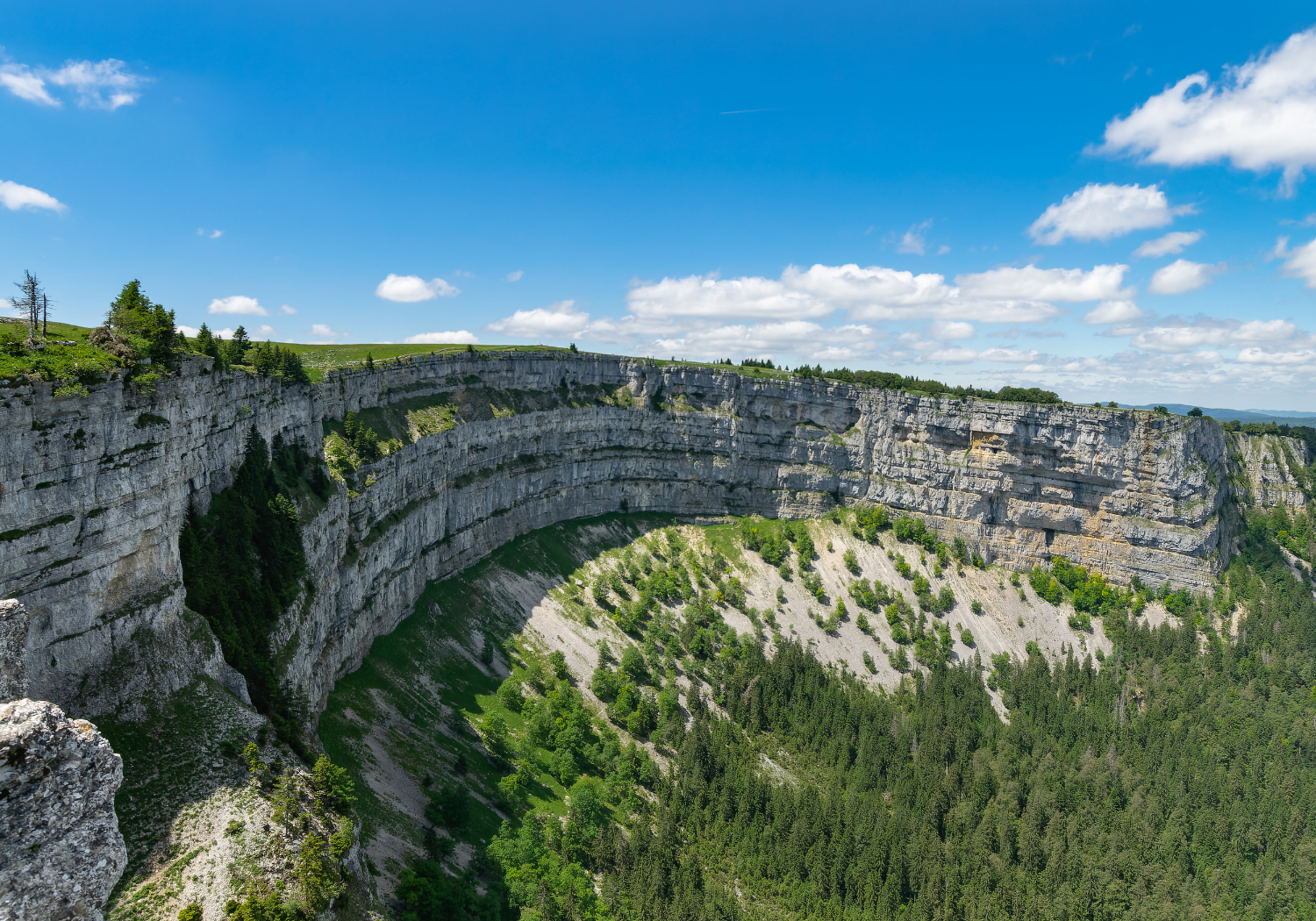
Most visitors to Switzerland head straight for the Bernese Oberland or the Matterhorn, queue for a cable car and pay accordingly. The Jura, the long limestone range along the French border, gets a fraction of that traffic and rewards walkers rather than sightseers. Its best-known feature is the Creux du Van, a natural rock amphitheatre roughly 1,400 metres across, ringed by vertical cliffs of more than 150 metres. There is no lift, no cog railway and no ticket office. You walk up, or you do not see it.
Autumn is when it works best. The air dries out, the view opens as far as the Alps, the beech woods turn, and the summer weekend crowds have gone. The practical detail that makes the whole thing easy: you can do it from Neuchâtel, on the lake, without a car.
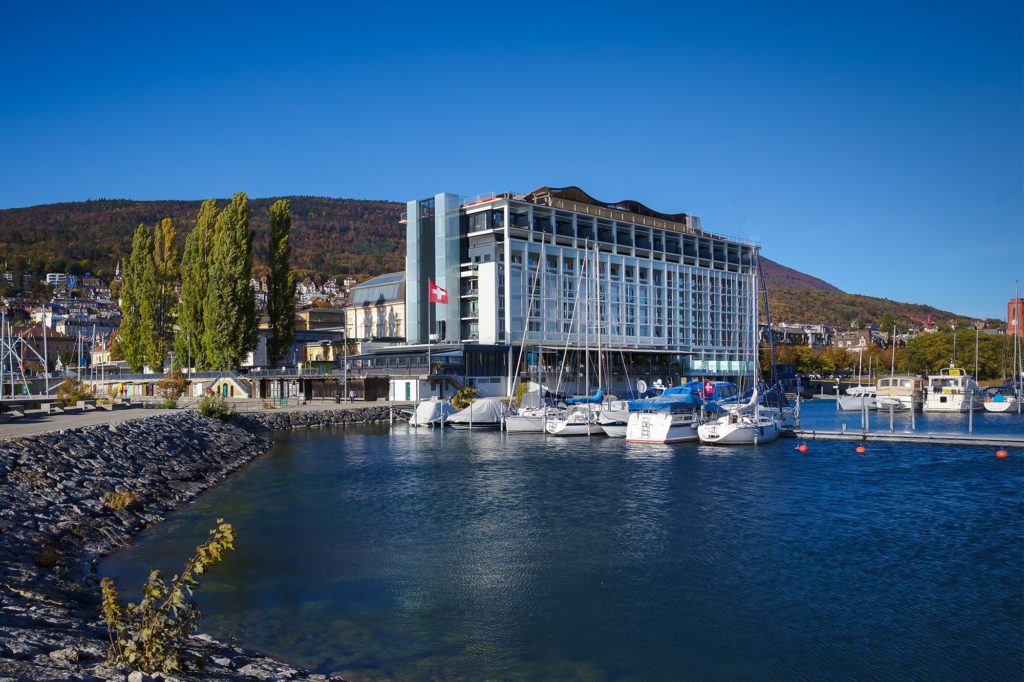
Book a room at Hôtel Beaulac on the lakeshore, a few minutes from the station, take the first train up the valley and be back by the water in the late afternoon.
A rock amphitheatre that comes into its own in autumn
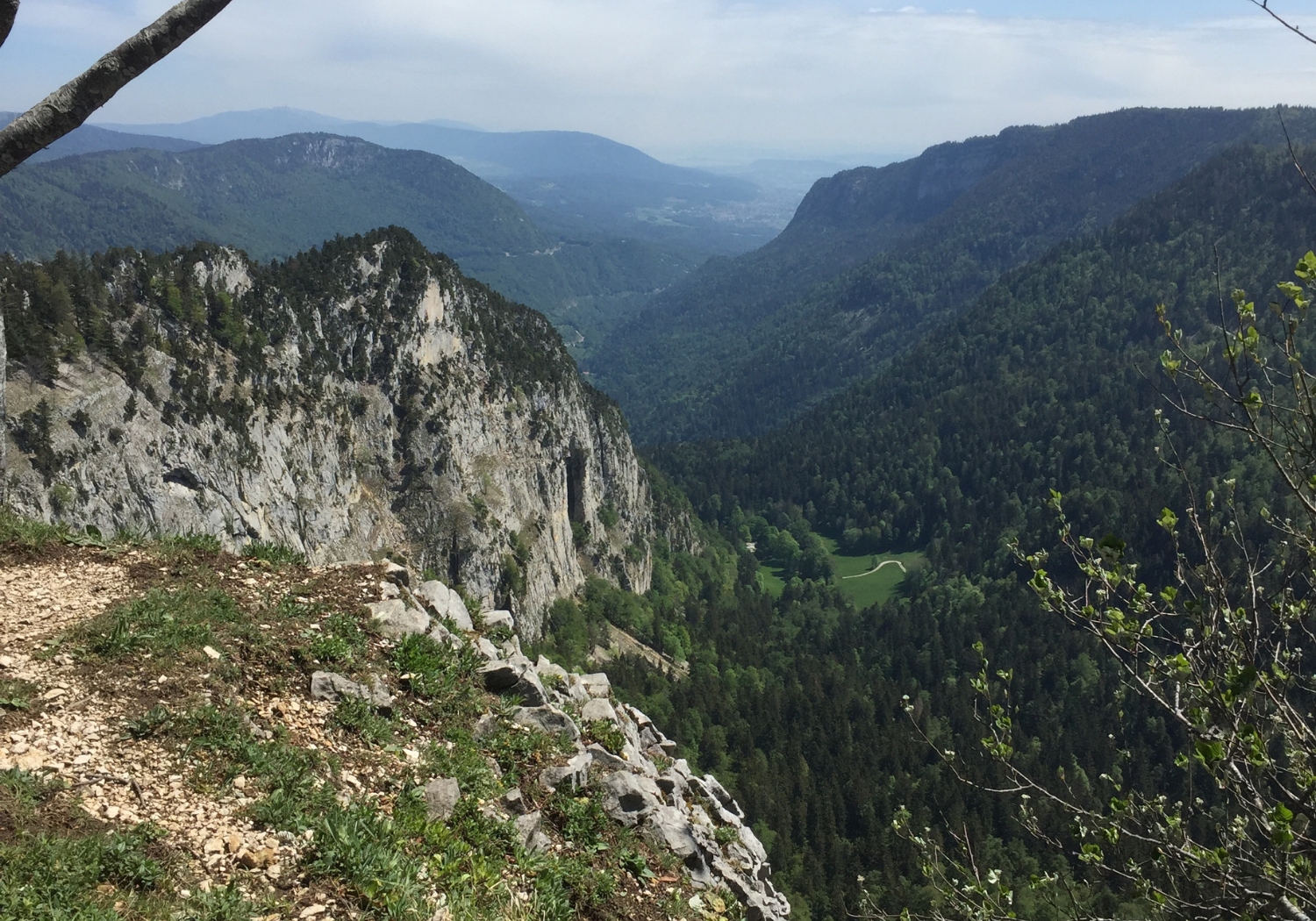
The Creux du Van sits on the boundary between the cantons of Neuchâtel and Vaud, a natural arena around 1,400 metres wide whose sheer walls enclose a wooded basin. It is sometimes called the Swiss Grand Canyon, which overstates the scale and understates the effect: the ground simply stops, and you are looking down a vertical drop.
The shape is glacial, carved by repeated freeze and thaw. The name is older. «Van» comes either from the Franco-Provençal word for rock or from the Celtic «vanno», meaning slope.
The site forms a nature reserve of roughly fifteen square kilometres that also takes in the Areuse Gorge and the Montagne de Boudry. A colony of about twenty ibex, reintroduced in the 1960s, lives here alongside chamois, roe deer, lynx and the increasingly rare capercaillie. Autumn brings the ibex down onto the ledges below the rim, where they can be watched from the path, often at close range. Bring binoculars and, more usefully, patience.
Reserve status means a few rules: picking plants and wild camping are prohibited, and dogs must be kept on a lead.
One autumn phenomenon worth knowing about: when low cloud settles over the Swiss plateau, the rim of the Creux du Van stands above it, and you look out across a sea of fog to the Alps. The webcams at the nearby mountain restaurants give a reasonable indication first thing in the morning.
The Sentier des 14 Contours: the classic route from Noiraigue
The path of the fourteen bends is the most satisfying way up and the only one that works entirely on public transport. Trains run hourly from Neuchâtel to Noiraigue and take about twenty minutes.
From the station, yellow waymarks lead you onto tarmac, then a stony track that steepens once you are into the woods. Allow roughly fifty minutes to the farm at Les Oeuillons, where there is a simple refreshment stop, then about an hour and a half for the fourteen bends up to Le Soliat. Each bend is numbered in yellow paint, which turns the climb into something you can measure rather than simply endure.
The arrival is abrupt in the best sense. You step out of the trees and the amphitheatre is there. The high point of Le Soliat is 1,463 metres; on a clear day the view runs south over the Neuchâtel lakeshore, north across the Val-de-Ruz and the Val-de-Travers, and on to the Alpine chain.
From there the path follows the rim, then drops to the Ferme Robert. Allow about an hour and a half for that section and a further thirty-five minutes back down to Noiraigue. On the way you pass the Fontaine Froide, an ice-cold spring at the foot of the cliff that runs cold year-round and is held in high regard by the absinthe drinkers of the Val-de-Travers.
Two things worth flagging. Along the rim a dry-stone wall separates the pasture from the drop, and you can walk on the safe side of it. The outer path, waymarked white-red-white, has no barrier at all and is not for anyone who dislikes heights. There is also a steeper alternative, the Sentier du Single, which many walkers prefer to use for the descent.
In total: around twelve kilometres, 700 to 800 metres of ascent, four to five hours of actual walking. Give it the whole day.
Planning an autumn walk
Daylight is the first constraint. By late October it is dark by about six in the evening, so leave Neuchâtel before nine and check your return train before you set off rather than after you come down.
Wet leaves and damp rock make the descent slippery, particularly on the roots and slabs of the Sentier du Single. Proper walking boots with ankle support and a decent tread are not overkill here. At 1,400 metres it can be at freezing point while it is still mild by the lake, so pack a warm layer and light gloves even when Neuchâtel is showing fifteen degrees.
For food along the way: Le Soliat is a mountain restaurant at 1,382 metres, right on the edge of the cirque, and the Ferme Robert sits at 972 metres at the foot of the cliff, serving regional dishes. Opening hours shift with the season and the upland farms close progressively as winter approaches, so a phone call in advance is worth the trouble. The Ferme Robert also has a free nature centre, open at weekends and on public holidays in season.
A word on driving. There is a car park in front of Le Soliat, five minutes’ walk from the rim, but the approach road from Couvet or from the Neuchâtel lakeshore is narrow and passing is awkward. It is the option for people in a hurry, and it removes the best part of the day.
Getting there from the UK
Neuchâtel is straightforward to reach. Trains from Geneva Airport take around an hour and a half, and the direct service from Zurich Airport runs in under two hours. If you are combining the trip with Bern, the two cities are thirty-five minutes apart by direct train. Autumn rates are lower than high summer across the region, and the trains are quieter.
A day in the Jura, an evening by the lake
This is where the combination earns its keep. The Creux du Van is a bare, physical sort of day out. Stepping off the train in Neuchâtel in the late afternoon and sitting by the water a quarter of an hour later is a contrast few destinations manage at such short range.
Hôtel Beaulac puts you on the lakeshore, minutes from the station. After six hours on your feet that means a shower, a table with a view over the water and, if the sky is still clear, a drink on the Waves rooftop. The following day needs no planning: the Areuse Gorge, the Neuchâtel vineyards and the old town are all within easy reach.
Book your autumn stay at beaulac.ch and make the Creux du Van the first day of a weekend by the lake rather than a trip on its own.